

eSIM vs physical SIM: what actually changed
The useful difference is not plastic versus software. It is how fast a line can be delivered, moved, recovered, and managed.



Install
Physical SIM: Insert a card, or wait for one to arrive.
eSIM: Scan a QR code, tap a link, or install from an app.
Travel
Physical SIM: Buy a local SIM, swap cards, keep the old one safe.
eSIM: Add a travel plan before you fly and switch data when you land.
New phone
Physical SIM: Move the card, or ask the carrier for a replacement.
eSIM: Transfer or re-issue the line digitally, where the carrier supports it.
Business control
Physical SIM: Track cards, couriers, receipts, and carrier portals.
eSIM: Issue, monitor, top up, and stop access from software.
The paperclip era
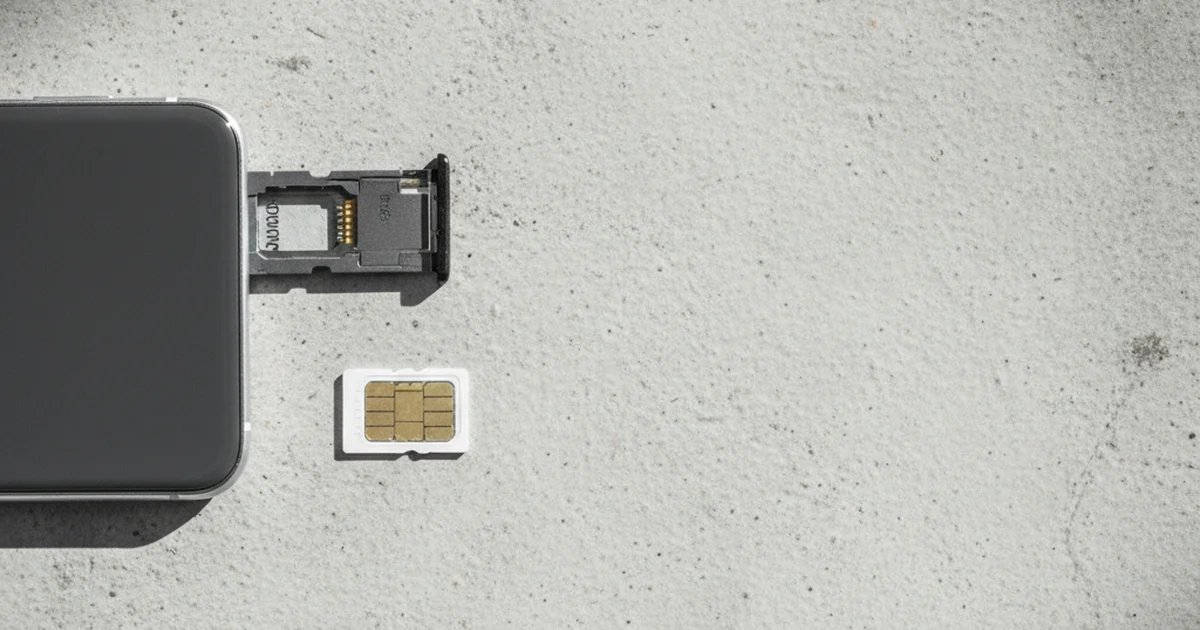
Anyone who has swapped a SIM in an airport queue knows what physical SIMs cost you. Pop-out tray. Paperclip. Nano card on the floor of a taxi. Ninety seconds of network search. Back of the line.
The card was a logistics object pretending to be a service. The carrier needed it to identify you. Everything else, the manufacturing, the postal handling, the inventory, the activation desk at the store, was a workflow they had to build to make the card work. You did the last mile of that workflow yourself, every time.
That was the cost of mobile. Not the data charge. The friction around the data charge.
The card was a logistics object pretending to be a service. The eSIM is the service without the logistics.
A new phone, in five minutes
The eSIM moment most people notice first happens at iPhone setup. Unbox the new phone. Hold it near the old one. The line you've had for fifteen years moves across during initial setup. Your two-factor codes start arriving before you've finished transferring photos. Quick Transfer takes about five minutes.
Compare that to the routine before eSIM: open the old phone, pop the tray, fish out the nano SIM, slot it in the new tray, watch the device hunt for a network, sometimes call the carrier because the activation didn't go through. The card was the bottleneck.
The scenario that breaks the old model entirely is when you lose the phone. There is no tray to retrieve. With eSIM, the carrier or platform can re-issue your line to a new device by sending a link. The phone number you've had for fifteen years comes back in three taps. Pre-eSIM, this meant a store visit, an ID check, a wait for a courier, and two days without your primary line, which usually doubles as your two-factor route into your email.
The hotel room moment
You land in Tokyo on a Tuesday at 11pm. The hotel WiFi is broken. Pre-eSIM, this is when you remember the paperclip lives in your toiletries bag, which is in the suitcase you've checked back in at the airport because the room isn't ready yet. You hunt the lobby for a metal earring. The local SIM the concierge can sell you needs a passport scan and a 20-minute setup. By the time you have data, it's midnight.
With eSIM, you open WhatsApp at the front desk, message a bot, pay $9.99, tap install. Two minutes. The connection lights up before your shoes are off. The whole "new country, no signal, no plan, no card to put in" pattern that anyone who travelled in 2014 remembers, gone.
New shape of vendor
The most interesting consequence is on the supply side. Before eSIM, the companies that could connect you to a mobile network were the ones who ran the network and could manufacture SIM cards. The card itself was the control point. Producing it meant a secure-element supplier, a personalisation bureau, a GSMA-credentialed factory, and a chain of custody from factory floor to retail counter. Resellers and MVNOs could exist, but only by buying inventory from someone with all of that already built. The barrier to entry was billions of dollars of network and a SIM-card production line.
eSIM turned the unit of inventory into an API call. Provisioning a line is a request to the carrier's SM-DP+; delivery is a URL; the secure element is the eUICC already soldered into the device. The carrier negotiation still happens. The factory floor doesn't. Mobile connectivity stopped being something only the companies running the network and stamping cards could offer.
Now you have:
- Travel apps adding eSIM purchase alongside flight booking.
- Fintechs offering mobile data on a virtual card the same way they offer FX.
- AI assistants buying and installing eSIMs in a single chat.
- Connectivity platforms (us included) treating the eSIM as an API endpoint, not a SKU.
Some of these shouldn't be possible. A consumer-facing eSIM brand that has never touched a SIM tray. An MVNO that ships brand-new in three weeks instead of two years. A multi-tenant platform where one operator runs five brands without a warehouse. None of these existed in 2018. None of them could have.
Connectivity stopped being something you ship in a padded envelope. That's the actual change.
What changed for travel and business
Travel got friction-free. The eSIM you bought before your flight is active by the time the seatbelt sign goes off. The trip-by-trip plan is a 20-second purchase instead of a 20-minute one. The "set up data for this country" decision doesn't have a logistics tax on it any more.
Business mobile got operationally easy. The line your IT team provisioned for a new hire is in their inbox before their laptop arrives. When an employee leaves, stopping company mobile access is one action, not a courier and a follow-up. The travel team that used to send a calendar reminder ("don't forget to log into the carrier portal") doesn't need to.
Both of these were possible before eSIM. They were just expensive in time and friction. The change isn't "everything is cheaper" (sometimes it isn't). It's that what previously cost you a half-day of admin now costs you a tap.
What eSIM still doesn't fix
Plenty of carriers haven't rebuilt their workflow around it. They treat the eSIM like a SIM card with the plastic removed. You sign up online, but activation needs a store visit and an in-person ID check. Or they post you an "eSIM activation pack", a paper insert with a QR code on it, which arrives in two working days. Or the call-centre is the only path to move the line to a new device. The phone supports eSIM, the standard supports digital provisioning, and the carrier kept the logistics workflow anyway. The result is someone tries an eSIM, has an underwhelming first hour, and blames the hardware, when what they actually ran into was an incumbent that hadn't moved.
The smaller gaps are technical. Dual-SIM on Android is still uneven by carrier. The transfer-between-phones flow works cleanly on iPhone and is patchier on Android. Some emerging markets default to a physical SIM purchase because the last-mile habit hasn't shifted. The QR install is mildly stranger than slotting a card the first time you do it.
None of these are permanent. The carrier workflow gap is the one that lasts longest, because the rest of the incumbent's business depends on the workflow staying the way it is. The technical gaps shrink every quarter. Once a market has eSIM and a digital-native vendor lands in it, what looked like an edge case becomes the default within a release or two.
From spec to flagship
The eSIM standard for consumer phones was published in 2016. The Apple Watch Series 3 in 2017 was the first widely-shipping consumer device with cellular eSIM. The iPhone XS in 2018 was where most people first met one in their pocket. Pixel and Galaxy followed in 2018 and 2019. Roughly a decade from "the spec exists" to "every new flagship supports it".
That's the part worth holding on to. The Tokyo hotel moment, the IT team's offboarding workflow, the AI assistant buying you a line in a chat: all of it became possible inside ten years. Most infrastructure shifts take three times as long. The reason this one moved quickly is that the eSIM didn't just digitise the card. It removed an entire category of physical handling from the supply chain, and once that goes, everything downstream tends to follow.
What's next
iSIM is the next step in the standard. The SIM moves onto the device's main processor instead of sitting on a separate chip. For consumers, nothing changes. For device makers, it removes one more component.
The bigger story is which devices that unlocks. Cars need connectivity for telematics, over-the-air updates, and in-cabin experiences. Wearables need cellular without taking battery, board space, or a tray you have to design around. Industrial sensors need a SIM that survives ten years in heat, vibration, and humidity. Slotting a plastic SIM into any of those was always awkward; embedded and integrated SIM remove the awkwardness.
Connectivity follows the silicon. As eSIM and iSIM ship in more device classes, the addressable surface for managed connectivity grows from phones plus a handful of IoT specialists to every device class with a CPU. And the same pattern repeats: the moment the logistics tax drops, a new wave of providers arrives, each tuned to a specific segment. Fleet telematics platforms. Wearable-line management. Medical device connectivity. Industrial sensor estates. Categories that wouldn't have existed under a SIM-card-shipping business become natural fits for the next generation of platforms.
We're one of those platforms for phones today. The same playbook works in every adjacent device class. That's worth thinking about every time a new mobile-connectivity company shows up in your feed: it isn't a feature change in the carrier industry. It's a barrier drop, and the next ones over are queuing up behind it.
Get started with eSIM Copilot
Try the part that wasn't possible before
Buy a travel eSIM in WhatsApp, set up business mobile for your team, or build eSIM into your own product. All on the same platform.
Written May 2026. Carrier workflows, Android transfer support, and eSIM availability still shift quickly; expect the edge-case sections to age faster than the core pattern.