




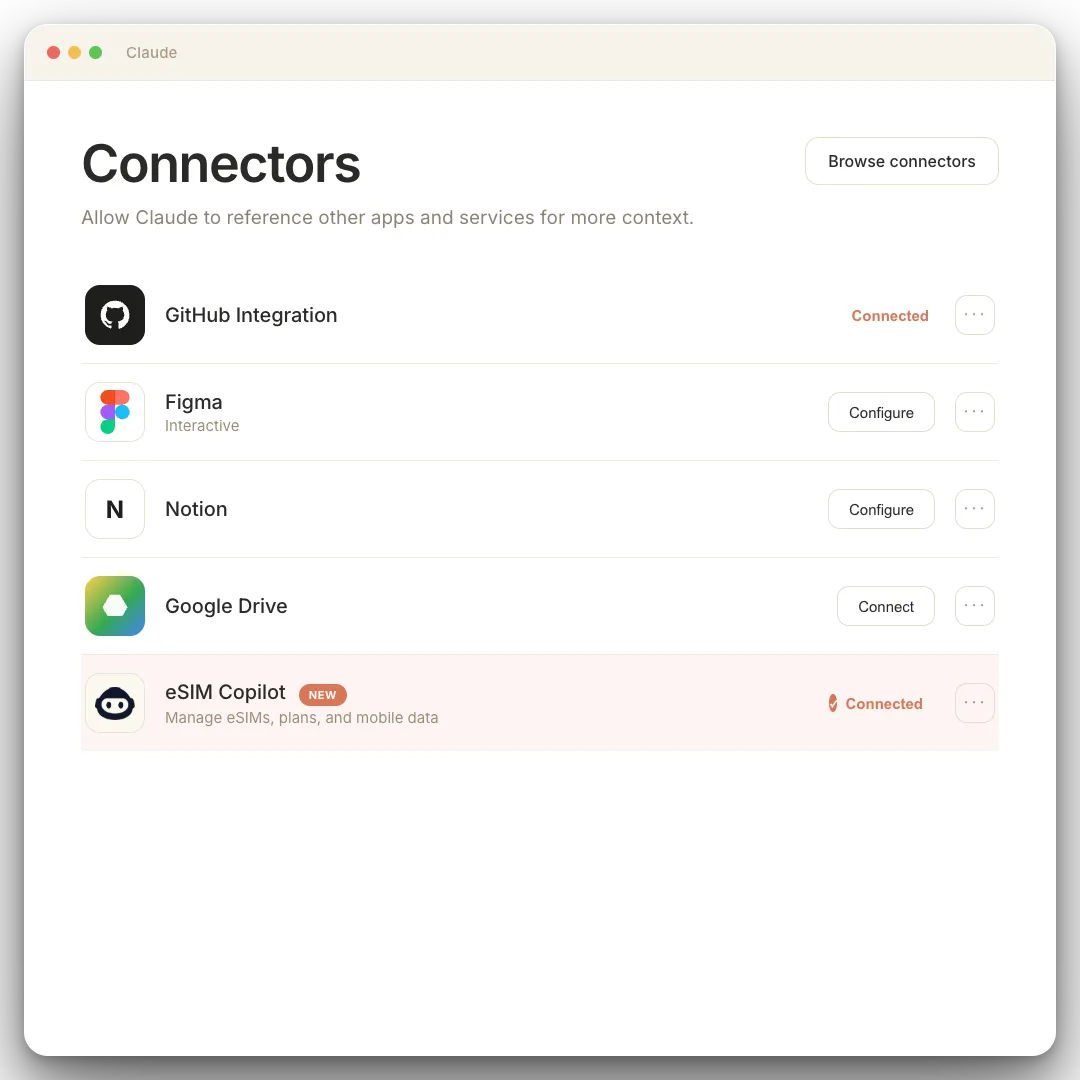
eSIM Copilot, sitting alongside the rest of your business tools in Claude.
Your CRM, finance, HR, docs and calendar have been connected to AI for years. You can query them and act on them through a conversation with Claude.
Mobile was the exception. It isn't anymore.
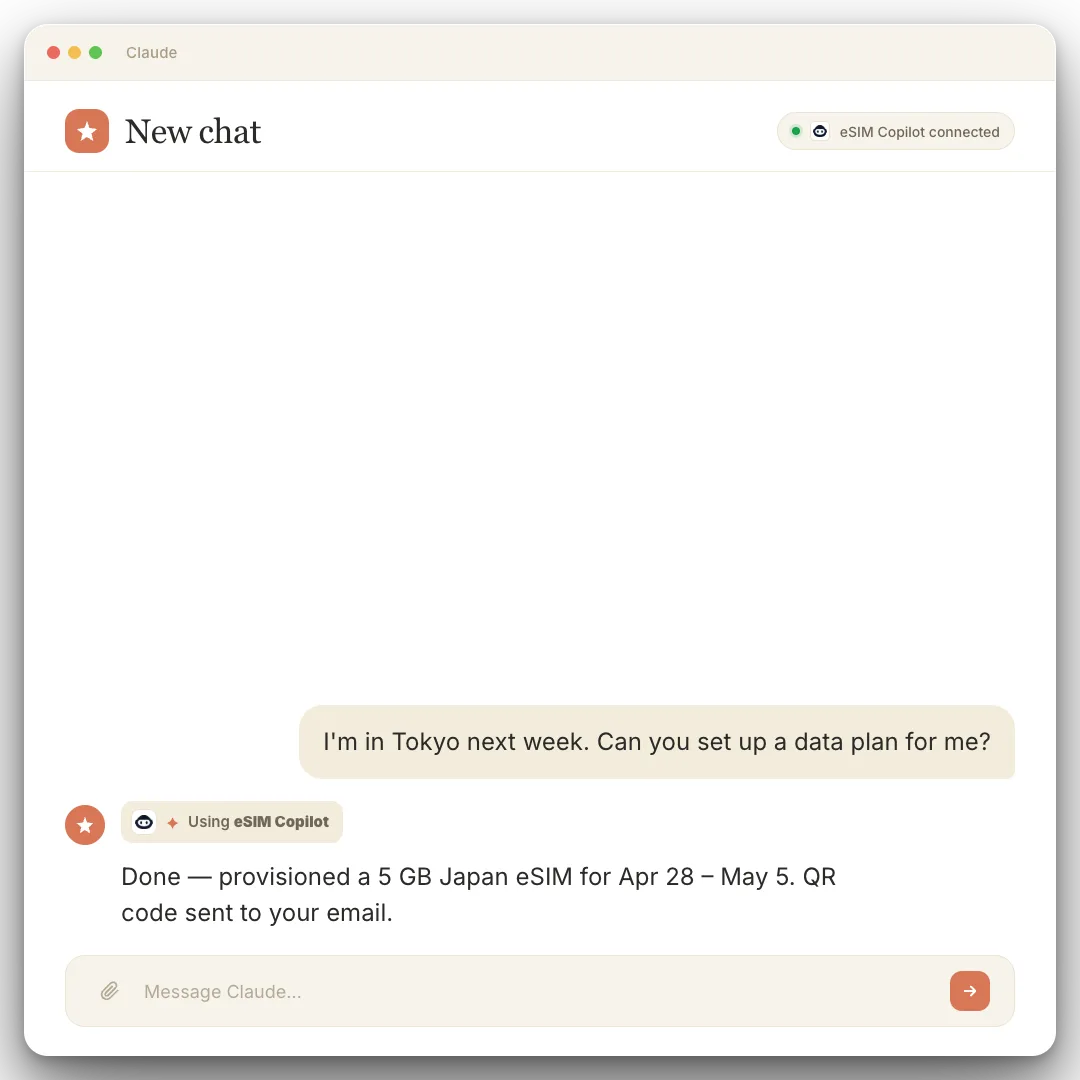
eSIM Copilot is now a fully integrated MCP server for Claude, which puts your phone lines, plans, spend, usage, approval rules and team data inside the same conversational layer as the rest of your business. Mobile stops being the chore nobody wants to own and becomes a set of questions you can ask.
Why mobile management felt broken
For years, running mobile for a business has meant a carrier portal, a spreadsheet someone updates at month end, and a queue of tickets when things break.
The tools themselves weren't the issue. They were just sealed off from everything else. Your mobile estate lived in a system of its own, disconnected from the finance tools that paid the invoices, the HR tools that onboarded new starters, and the service desk that picked up the pieces.
So any question that cut across systems needed a human with a spreadsheet sitting in the middle. Which departments are overspending on roaming. Which lines haven't been touched in 60 days. What the same usage would cost on a different provider.
That's the gap we built eSIM Copilot to close.
What you can do from Claude
Plug eSIM Copilot into Claude and you manage mobile by asking questions.

A few concrete examples.
Savings analysis

Upload an invoice from your current mobile provider. Claude reads it, maps each line against our catalogue, and tells you precisely how much you'd save, broken down by line, department, country. That's work that used to tie up a procurement consultant for a fortnight.
Bulk onboarding
Paste in a list of 40 new starters. Claude provisions the eSIMs, picks the right plan for each one, pings the relevant managers, and ships the QR codes. No CSV wrangling. No ticket queue.
Real-time control
Tell Claude, in plain English, to ping your finance Slack channel whenever a line crosses a spend threshold or a device lights up on an unexpected roaming network. You describe the rule. Claude wires it.
Cross-system intelligence
Because Claude can see your HR system and your mobile data in the same window, questions that used to be hypothetical become trivial. Who's travelling to Japan next month without a local plan? Run the expense claims for international calls against actual usage in eSIM Copilot, are we billing ourselves twice somewhere?
Visibility into the live network
Most mobile tools stop at billing and provisioning. They show you what you bought and what it cost. They don't show you what the network is doing right now.
eSIM Copilot does. And Claude turns that into a conversation.

Questions you can ask, today
- Which network is each person on my team currently connected to? Claude returns the live list, grouped by carrier and country.
- Where in the world are my active lines right now? Ask for a summary by country, by department, by user, whatever cut you want.
- Which eSIMs have been downloaded but never activated? Which are sitting in "Ready to Install" three weeks after being provisioned?
- What devices are my eSIMs installed on? Claude can tell you make, model and EID for every profile in the estate.
- How many of my lines have an active session right now?
None of this was easy to ask before, not without logging into a carrier portal one SIM at a time or building your own reporting stack. Through Claude, it's one question.
Mobile data is finally as easy to query as the rest of your business data.
The bigger shift
You can manage mobile through a chat now. That's useful. It isn't the thing that matters.
What matters is that mobile data is finally as easy to query as the rest of your business data. A CFO can answer mobile spend questions without going through IT. IT can answer finance questions without building a spreadsheet. Developers can build on top of a live connectivity API without learning yet another product.
This isn't a chat window bolted on to a portal. It's mobile connectivity treated as code.
What you can build on top
Because eSIM Copilot is a complete MCP server, anything Claude can build, it can build against your mobile estate. We've already seen customers spin up:
- Branded self-service portals that employees log into without ever seeing eSIM Copilot behind it.
- Savings dashboards that update as plans get used.
- Onboarding flows that provision a mobile line the second a new hire lands in the HR system.
- Internal Claude skills that fire a runbook when a specific network event happens.
None of these went through a product team. They were built by people with a Claude subscription and a clear idea.
Why now
A few things have lined up at once. eSIM has taken over from the physical SIM for most business use cases. MCP has settled in as the standard way for AI agents to reach into business tools. And Claude now has the reach to act on your behalf across multiple systems without losing the thread.
Stack those together and “log into a portal to manage your mobile estate” starts to feel like a relic. The businesses who'll get the most out of what comes next are the ones willing to rethink what mobile management even is, not the ones still logged into the same dashboard they were logged into in 2015.
Try it against your own data
If you run mobile for a business, or you're building one, eSIM Copilot inside Claude is live today. Talk to us and we'll show you what this looks like against your own invoices, your own data, and your own questions.
Michael Moorfield
Founder, eSIM Copilot